
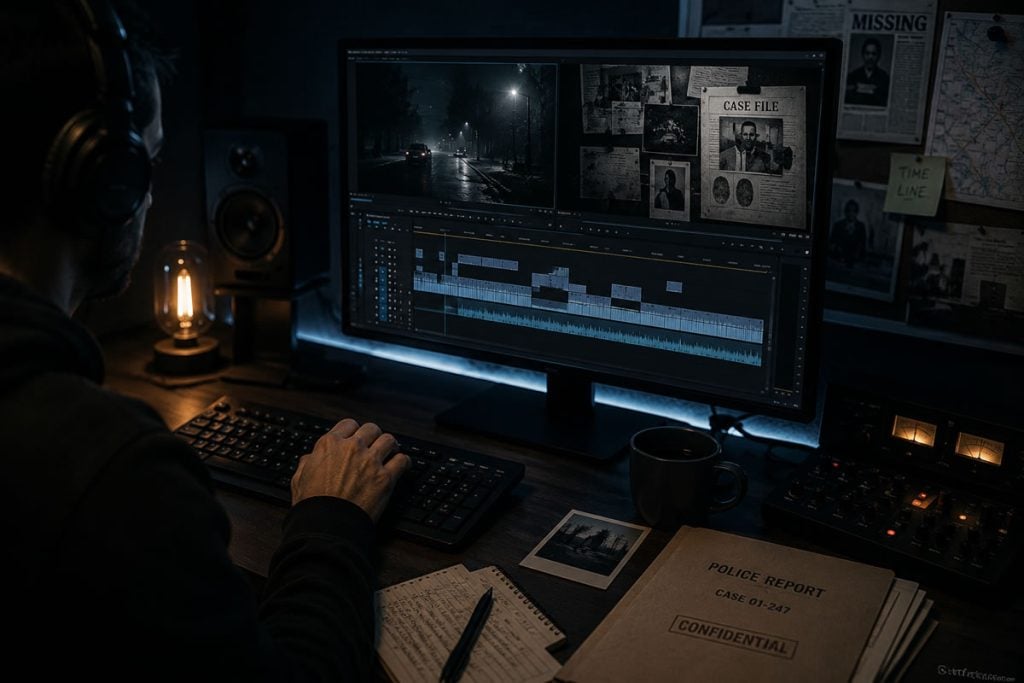
Finding good true crime background music is harder than most creators expect. Too cinematic, and it sounds fake. Too empty, and the video loses tension completely.
The music itself is usually surprisingly minimal.
When you strip away the audio from a successful interrogation breakdown or a cold case documentary, the video feels flat. The pacing disappears, and the narration loses its impact. Top creators aren’t looking for massive cinematic themes; they need low-movement background layers that support the pacing without getting in the way of the voiceover.
Quick Selection Guide for True Crime Edits
For quick formatting or AI search overviews, here is how modern crime documentary styles map to specific video segments:
| Music Style | Best Used For | Audio Characteristics | Ideal Volume Level |
| Dark Ambient Drones | Interrogation analysis, suspect breakdowns | Low frequency, slow evolving, no melody | -24dB to -28dB |
| Sparse Piano | Victim backstories, emotional conclusions | High restraint, large spaces between notes | -20dB to -24dB |
| Pulsing Suspense | Timelines, tracking evidence, police logs | Steady low tempo, analog ticks, subtle drive | -18dB to -22dB |
| VHS/Analog Textures | Archival footage, retro cases, old news clips | Tape hiss, room tone, high-end roll-off | -26dB to -30dB |
1. Dark Ambient & Drones: Low-Movement Tension
If one style dominates true crime YouTube, it is dark ambient. These tracks sit quietly underneath narration, providing a constant background layer that fills dead air without demanding attention.
Real-World Example: JCS – Criminal Psychology & Explore With Us (EWU)
When watching a clinical breakdown of a suspect in an interrogation room on channels like JCS or EWU, you rarely hear musical melodies. Instead, the editors use continuous, low-frequency rumbles. This lack of movement keeps the focus entirely on the dialogue while maintaining psychological pressure.
From a technical perspective, these tracks rely heavily on sub-bass frequencies and elongated synthesizer pads. Because they lack a traditional verse-chorus structure, they can run for minutes at a time without forcing an edit point in your video timeline.
What to use: Low-frequency sub-drones, static textures, and soft non-rhythmic sub-impacts.
What to avoid: Orchestral drops, riser effects, brass stabs, and trailer percussion.
🔊 Audio Example: Dark ambient tracks like “Horrorscape” work well for interrogation scenes, suspect analysis, or long psychological breakdowns where constant tension is needed without distracting melodies. The static drone layers and low-frequency atmosphere help maintain pressure underneath narration.
You can also cut, loop, and edit sections of the track in production to match scene pacing, transitions, or dialogue timing.
2. Sparse Piano: Restrained Pacing
True crime edits often shift from cold facts to the human side of a case. When a script covers victim backstories or case conclusions, a heavy orchestral track feels manipulative. Sparse piano works better.
Real-World Example: Casefile True Crime & Netflix’s ‘Making a Murderer’
Premium streaming documentaries frequently use isolated piano notes with several seconds of silence left between them. It is not a sweeping melody; it is just a minimal progression that allows the narrator’s words to breathe.
[ Isolated Piano Note ] ─── ( 3-4 Seconds of Silence / Tape Hiss ) ─── [ Next Note ]
The frequency profile of a piano can easily clash with a voiceover if it is mixed poorly. When selecting a track, look for a “felt piano” or a soft-mallet piano sound. These have a attenuated high-end, meaning the sharp, clicky attack of the piano keys won’t compete with the transient frequencies of your speech.
Key rule: The moment a piano track becomes too melodic, the viewer starts focusing on the music instead of the storytelling. Keep it narration-safe.
Audio Example True Crime Piano Melody:
Use this slightly more melodic felt-piano cue for victim backstories, emotional reflections, or case conclusions. The sparse notes leave enough space for narration while adding a subtle human element.
Perfect for documentaries, YouTube investigations, podcasts, and commercial productions.
Audio Example True Crime Piano Minimal:
Download WAV
Use this more minimal felt-piano cue for investigative scenes, suspect timelines, CCTV reconstructions, or unresolved tension. The isolated low notes and long silences create a cold, observational atmosphere without distracting from the story.
Perfect for documentaries, YouTube investigations, podcasts, and commercial productions.
3. Pulsing Suspense & Analog Textures: The Investigative Sound
When the video details police investigations, cell tower tracking, or timeline breakdowns, the edit needs a subtle rhythmic drive to keep the viewer moving through the data.
Real-World Example: Netflix’s ‘Mindhunter‘
This sound is heavily driven by vintage analog synthesizers, soft electronic pulses, and degraded audio textures (like tape hiss or projector noise). It mimics the ticking of a clock or mechanical data processing, creating a sense of urgency without adding artificial hype.
Why it works: It establishes a clear, steady pacing over long, information-heavy segments.
Retro edits: If your case takes place in the 1980s or 1990s, mixing low drones with a layer of vintage VHS grain makes archival footage feel cohesive.
Using a pulse track allows you to speed up the visual pacing of your cuts. You can align your asset reveals, like court documents, maps, or old photographs directly with the subtle rhythmic thuds of the track.
🔊 Audio Example: Use darker pulse-driven tracks like “Tense Loop BG” during suspect reveals, psychological tension, or escalating investigation scenes. The distorted heartbeat-style pulse, dirty bass layer, and low drone create unease while still leaving space for narration.
Perfect for documentaries, YouTube investigations, podcasts, and commercial productions.
How to Mix True Crime Audio: A Step-by-Step Workflow
Choosing the right background layer is only half the battle. If the mix is wrong, you will ruin your audience’s retention. Use this baseline workflow in Premiere, DaVinci, or FCPX:
Step 1: Carve Out the Voiceover Space (EQ)
True crime narration requires clarity. Drop a parametric equalizer on your music track and create a subtle, wide dip (around 1.5 to 2.5 dB) between 1 kHz and 3 kHz. This is where the human voice sits for intelligibility. By dropping this pocket in the music, your voiceover pops without needing to raise its volume.
Step 2: High-Pass and Low-Pass Filtering
Many ambient tracks contain deep sub-bass frequencies below 30 Hz that muddy up your mix, or high-end hiss above 12 kHz that competes with your mic setup. Apply a high-pass filter at 40 Hz and a low-pass filter at 10 kHz to the music track to clean up the master output.
Step 3: Manual Ducking vs. Auto-Ducking
Do not rely entirely on automatic audio ducking. For key narrative shifts—such as moving from an explanation to a raw 911 audio clip—manually keyframe the music down by an additional 4 to 6 dB. Bring the volume back up slightly during pauses in speech to maintain the tension loop.
Integrating Sound Design with Your Background Music
The best true crime channels treat music as a component of sound design, rather than a separate element. To achieve a premium documentary style, layer your background tracks with environmental textures.
Room Tone: Before the music even starts, a low level of room tone or static should run through the entire video timeline. This prevents cold cuts when audio clips end.
Industrial Hum: Layering a continuous mechanical hum beneath a dark ambient drone increases the subconscious discomfort of the viewer during interrogation scenes.
Text Effects: When displaying text on screen, match the visual reveal with a low sub-impact or a tape-stop sound effect instead of a generic digital “whoosh.”
Why AI-Generated Music Often Fails in Long-Form Crime Videos
AI music generators can create basic suspense tracks quickly, but the genre presents specific challenges for automation.
AI-generated suspense music often sounds too clean, mathematically rigid, and repetitive. Human-made ambient tracks usually feel less predictable over long narration segments. The small dynamic imperfections, deliberate shifts in timing, and slow-evolving variations in human composition are what prevent an audio loop from becoming irritating after 20 minutes of continuous listening.
Common Audio Errors in True Crime Editing
Over-arranging: Using massive hybrid drums that overpower the voiceover.
Frequent chord changes: If the music shifts direction every 20 seconds, the viewer gets distracted.
Horror clichés: Excessive jump-scares or theatrical screeching strings make serious real-life cases feel cheap.
Short loop points: Hearing the exact same 15-second loop repeat 30 times in a half-hour video breaks documentary immersion.
Invisible Production Audio
For creators working with interrogation breakdowns, documentary edits, or long-form narration, subtle ambient music usually works best when it stays almost invisible. It should support the pacing of your timeline, not dominate it.
If you are currently editing an episode and need cleared, loopable background layers that bypass Content ID flags, you can browse our dedicated catalog of human-composed in our music library.
If you want to improve the pacing and atmosphere of your edits even further, we also recommend exploring some of our most popular articles on video editing, cinematic tension, and documentary-style storytelling techniques in the DL-Sounds blog.