
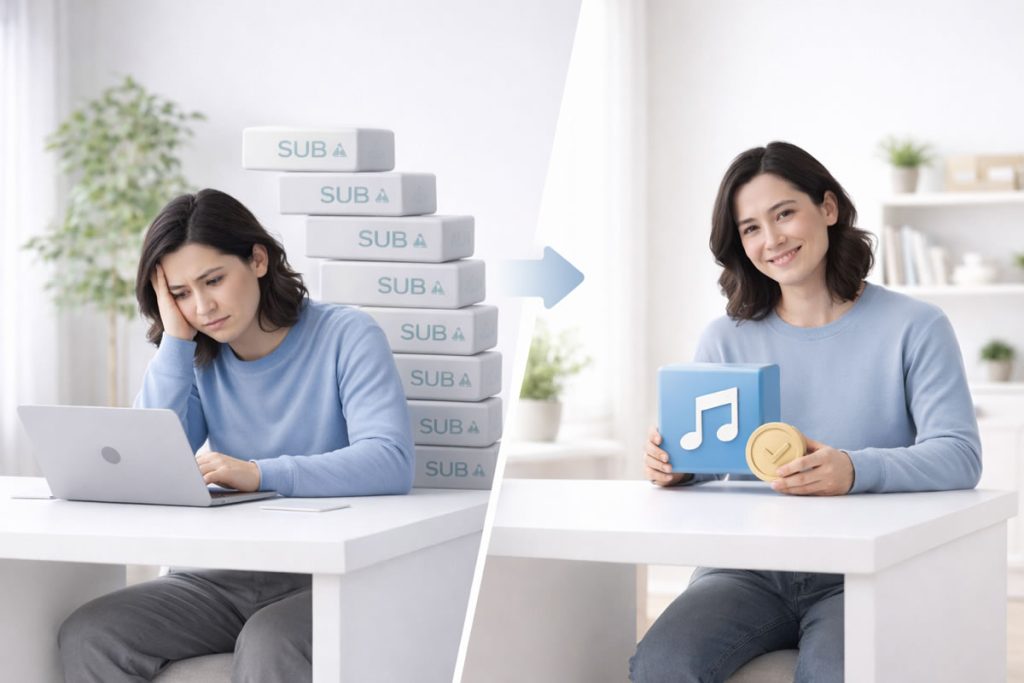
Creators are becoming more intentional about how they spend their money. As digital tools increasingly rely on recurring payments, flexibility and control matter more than unlimited access. This shift is especially visible in the royalty free music market, where subscriptions have become the default.
At dl-sounds.com, this change in creator behavior led us to introduce pay-per-track licensing alongside our membership plans. This article explains why no-subscription music matters, how pay-as-you-go licensing works, and when buying a single track is the better choice.
1. Subscription Fatigue and Why Creators Avoid Another Music Subscription
Creators today manage multiple subscriptions at the same time. Video editing software, design tools, cloud services, marketing platforms, and royalty free music libraries all require ongoing payments.
This accumulation of recurring costs is commonly referred to as subscription fatigue. Subscription fatigue describes the mental and financial pressure users experience when they feel overwhelmed by subscriptions they do not consistently use.
External definition and context:
https://www.digitalroute.com/resources/glossary/subscription-fatigue/
For creators who only need music occasionally, another recurring subscription often feels inefficient rather than helpful.
2. Why Most Royalty Free Music Libraries Use Subscription Models
Most royalty free music libraries rely exclusively on subscription-based pricing. Users pay monthly or yearly and gain access to music as long as the subscription remains active.
This model works well for creators who publish frequently and need large volumes of music. However, it assumes consistent usage, which does not reflect how many freelancers, agencies, and small businesses actually work.
Project-based workflows and short-term campaigns rarely align with fixed monthly costs.
3. What Pricing Looks Like in Practice
To support different creator workflows, dl-sounds.com offers both pay-per-track pricing and memberships.
Pay-Per-Track
Single audio licenses starting from $1.99
Higher-tier tracks up to $9.99
One-time payment per track
No subscription required
Memberships
Monthly plans starting from $12.99 per month
Annual plans up to $99 per year
More details about what is included in each membership plan can be found on the subscription overview page.
Subscription Plans. Subscription Plans
4. When Subscription-Based Music Does Not Fit Project-Based Workflows
Not all creators produce content every week. Many work in cycles, with busy production periods followed by quieter months.
Common issues with subscription-only music libraries include:
paying during months with no downloads
cancelling and restarting subscriptions repeatedly
feeling pressure to download tracks just to justify the cost
These frustrations are not caused by the music itself, but by pricing models that lack flexibility. A single track license means you purchase the right to use one specific music track for your project with a one-time payment, without any ongoing fees or subscription.
5. Pay-Per-Track Music Licensing as a No-Subscription Alternative
Pay-per-track licensing offers a no-subscription alternative that matches real usage patterns.
With a pay-per-track or single track license, creators can:
buy exactly one track when needed
pay once instead of committing monthly
keep music costs directly tied to individual projects
Memberships remain available for high-volume users, but they are no longer the only entry point.
6. Pay-As-You-Go Royalty Free Music vs Subscription Libraries
Single Track License vs Music Subscription
| Feature | Pay-Per-Track (Pay As You Go) | Subscription |
|---|---|---|
| Recurring payment | No | Yes |
| Single track license | Yes | No |
| Cost when unused | None | Continues |
| Best for occasional projects | Yes | No |
| Best for frequent publishing | No | Yes |
| Budget control | High | Medium |
| Subscription fatigue | None | Common |
This comparison is not about replacing subscriptions, but about offering a practical alternative.
7. Who No-Subscription Royalty Free Music Is Best For
Pay-per-track royalty free music is especially suitable for:
freelancers working per client or per project
small businesses running occasional ad campaigns
agencies with irregular production schedules
people who only need music for a single project or specific moment
- low-budget productions where every expense must be justified per project
For these use cases, a single track license often feels clearer and more predictable than a subscription.
8. How Pay-Per-Track Works on dl-sounds.com
How to Buy Royalty Free Music Per Track Without a Subscription
The pay-per-track process is intentionally simple.
Browse the music library
Select a track and purchase it once
Download the music and the license
Use the track in your project without recurring fees
Browse Music Library
No subscription. Buy only what you need.
9. When a Royalty Free Music Subscription Still Makes Sense
Subscriptions are still a strong option for certain creator workflows, particularly where music is needed on an ongoing basis rather than per project:
publish content frequently
manage multiple channels
need constant access to new music
For these workflows, memberships can be more efficient than purchasing tracks individually. This is why both options are available side by side.
10. The Hybrid Model: Pay Per Track or Subscription, You Choose
Offering both pricing models is a UX decision.
The hybrid model gives creators control. Users are not forced into a single pricing structure and can choose what fits their workflow today. If their needs change, the pricing model can change with them.
This sense of user agency reduces friction and builds long-term trust.
Conclusion: Pay-As-You-Go Music Reduces Subscription Fatigue
Subscription fatigue is a response to rigid pricing in a flexible world. Pay-per-track royalty free music provides a practical, no-subscription alternative for creators who value clarity, control, and transparency.
By combining single track licenses with memberships, dl-sounds.com supports different workflows without forcing unnecessary commitments.